Knee pain or discomfort can be a very common occurrence, whether you are involved in sports or not. That’s why I figured it would make for a great article! Let’s take a look and get familiar with the anatomy of the Knee Joint.
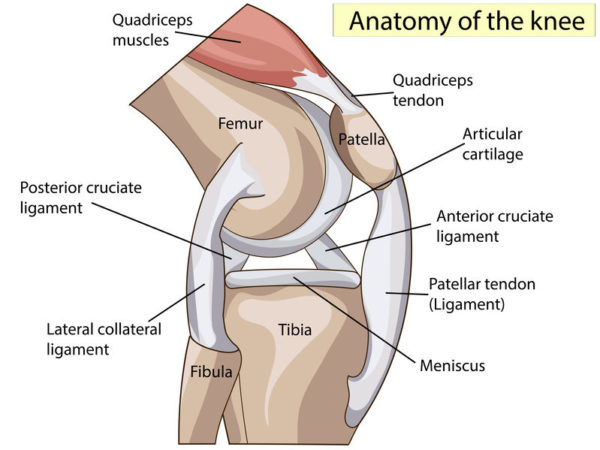
First things first, we are going to need to understand some of the terminology here. In this picture we have the following:
Bones: Femur, Tibia, Fibula, Patella. These should be relatively straight forward, but they are essentially the base of all muscle and connective tissue. Our bones provide the foundation & levers our body needs move us through space!
Ligaments: There are many different ligaments throughout the body and their primary purpose serves as joint stability. Regardless of the activity, there’s always outside forces acting upon our body, challenging our joint stability. Ligaments play a vital role in making sure that we aren’t only stability, but also strong through out that joint.
Muscles: Muscles have a wide range of purposes through out the body. In regards to today’s article, they are what make things move. When you bend or extend your knee, that’s all thanks to your muscles. How much weight you lift, that’s a primary result of how strong your muscles are at overcoming an outside force on your body.
Tendons: Tendons are the white end of the muscle that attaches the muscle itself to the bone. It aides in the muscle’s primary function of moving our joints through space.
Cartilage/Fibrocartilage: Cartilage serves as a cushion on top of our bones in areas such as our joints. The examples that we have here today would be the Meniscus & Articular Cartilage. Cartilage tissue helps high impact areas absorb compressive forces from our physical activity. This could be everything from walking, running, jumping, or lifting weights.
We will build off of this article in later segments when we look at how we should be training and recovering our body.
Thanks for stopping by and always reach out with any questions!


Leave a Reply